Thursday, February 16, 2012

on political suicide...

...and the dwindling of numbers.

Here are some thoughts that occurred to me today, in light of all the posts and concern over the (white, male, Santorumesque) efforts to impose new restrictions on women's healthcare that have recently unfolded.


Republicans just can’t help themselves. Their desire for exclusivity and to turn back the clock to, say, 1850 has gotten to the point where it would be hilarious if it weren’t so sad...

Strike that. It is hilarious.

Let's look at their efforts to reach out.

So they long ago alienated African-Americans, fighting at every turn as they did against any implementation of civil rights laws, and further, seeking to roll back what rights have been won by imposing new poll taxes and onerous voter ID laws designed to keep out the great unwashed on election day.

In Arizona, Alabama and now Georgia we’ve watched as what miniscule gains they made with Latino voters were erased in the slow-motion political and economic train wreck that is those states’ anti-immigration laws.

They’ve stood firmly with the one percenters, fighting tooth and nail against even gelded, toothless financial reforms, shrieking about government takeovers when people made the mild suggestion that the very rich--who have done so well under our system, and who the rest of us have very kindly declined to rob and murder--might like to pay a few percentage points more in taxes rather than see the country they supposedly love descend into a bloody, crumbling hellscape.

Gay rights--well. ‘Nuff said.

And now they’re doing their damnedest to alienate the 50.1 percent of the population who regularly visit a gynecologist--along with the unknown percent of the rest of the population who think women might have more to offer the world than to become the human version of factory-farm sows, lolling on their sides in a cage, spitting out child after child under the watchful eye of male supervision.

Jesus Christ! Keep up the good work, fellas!

Pass the popcorn--what we thought was the slow decline of the Republican Party may well turn out to be the end of the Republican Party in an apocalyptic firestorm--one of their favorite go-to visuals. And it might happen sooner than we think, if they continue to chase people out of their ever-shrinking ‘big tent.’

It occurs to me that if you support people who hate everyone, you're unlikely to have anyone support you.

Whoa. Zen for haters, man.

Tuesday, February 14, 2012

skeletons

Here's a piece that erupted spontaneously as I was working on my play this morning. It just kept going and going, and while it was way too long to use in the context of the play, I was having way too much fun with it to just toss it out. :-)

Enjoy.


Skeletons
If you’ve lived any kind of an interesting life, once you reach a certain age you’ll find that there isn’t a closet big enough to contain all your skeletons. You stuff the clattering bones in there as best you can. But before too long they start to spill out, little by little, bone by bone.

At first it’s just a metatarsal here, the end of a finger bone there, occasionally the odd tooth will roll out--embarrassing when you have guests, but it’s nothing that can’t be swept under the rug or kicked under the dresser. But soon, as the closet fills up, the bones that roll out get bigger--here’s a skull, there’s a femur; I knew him, Horatio. Where be your gibes now?

Before you know it, you’ve got complete skeletons piled in the corners of the bedroom.

You might find this amusing for a while. Maybe you stack them neatly at first, hanging clothes off them as if they were a neglected treadmill. Or maybe you pile them up with books and magazines as though they were shelving units from some macabre Ikea. You laugh at your skeleton sculptures along with your friends, with a small note of self-deprecation, just a touch of embarrassment, but no big deal.

But soon enough, the skeletons grow populous enough that you’re forced to start stuffing them under the bed. Eventually you’re jamming them into that space between the bed and the wall. One day, you’re in a hurry to get out the door and so you toss one on the end of the bed--just temporarily, just until you can get home that night and make some room for it...somewhere.

Before you know it, they’ve taken over the bed. You’ve got skeletons stacked like cordwood on your Tempurpedic mattress until they nearly reach the ceiling. Pretty soon there’s no room for you in your own bedroom anymore.

So you say fuck it, and you start sleeping at other people’s houses.

Which, of course, leads to more skeletons...
###

Friday, February 10, 2012

taming of the shrew review

Hey guys--here's my latest review in the Post. They just posted it online this morning and there's already a negative comment (about the review) so let the slagging begin. :D I think changing up Shakespeare is something that people either love or hate; no middle ground on it. So I am prepared for the slings and arrows.

(But when they add modern words and phrases??? Come on...)

Anyway. Here's the piece as I turned it in to the editors, and here's a link to the Post's published version. Let me know what you think!


THE TAMING OF THE SHREW

In a certain light, “The Taming of the Shrew,” a story about a husband “taming” his unruly, cantankerous wife, reads like a CIA “special rendition” handbook entry: psychological torture, sleep deprivation, withholding food--let the hilarity ensue!

And the blatant misogyny of the play isn’t only troublesome to modern audiences.
There is evidence that there has long been some degree of embarrassment about the subject matter, even some 300 years before women’s suffrage. This includes Shakespeare’s “induction,” a rarely-performed framing device that makes the entire story a play-within-a-play, as well as a sequel of sorts written by Shakespeare’s successor, in which the tamer Petruchio gets tamed himself by a new wife.

Examples like these would seem to argue against the view that the entire play was taken as satire in the late 1500s, that the Bard was mocking the harsh treatment of women by going completely over the top with it.

But misogyny or satire, the play is so often produced not only because it’s hilarious, with endless one-liners and situational humor--it also features a ten-round epic battle of wills between two of Shakespeare’s strongest, most vital characters, Petruchio and Katherine.

As imagined by director Kent Thompson, the couple (John G. Preston and Kathleen McCall) meets in a late-1950s diner owned by Katherine’s father in Padua. As illustrated on a huge map behind David M. Barber’s gorgeous set, Padua in this telling is located on the shores of Lake Michigan, Pisa is large city on the east coast, and Verona, Petruchio’s home, is deep in the heart of Texas.

When suitors Gremio and Hortensio (Randy Moore and John-Michael Marrs respectively) seek the hand of Katherine’s younger sister Bianca (Christy McIntosh) her father refuses to allow her to wed until the shrewish Katherine is married first. Enter Petruchio, friend of Lucentio (Drew Cortese), a suitor from Pisa also seeking Bianca’s hand, who convinces Petruchio to wed Katherine and thus secure a rich dowry.

The leads are all superb--especially McCall as Katherine--all fully fleshed-out, “real” people relishing the thrust and parry of attempting to win love.

What becomes distracting is how far Thompson goes with his Americanization of the characters. Here we are treated to a pistol-packing, “yee-haw”-yelling Petruchio mixing it up with Lucentio’s servants from “Pisa,” whose Italian accents make them sound like extras on hiatus from “The Sopranos.”

The show threatens at every turn to become “The Comedy of the Two Stereotypes”--most of Petruchio’s household servants appear to be brain-dead, slack-jawed rejects from “Deliverance,” thus cementing for us the last two groups one can safely make fun of without being thought of as small-minded: Southerners and Jersey Shore rejects.

I suppose if you’re going to do a play in which the major point on which the plot turns is the subjugation of a woman, you might as well go for the prejudice trifecta.

Granted, some of these additions are genuinely funny. Patrick Halley as Lucretio’s
servant Biondello is a scene-stealer with tremendous comic timing, playing him as a sort of hyperventilating Lou Costello. And Preston’s Verona-on-the-Rio dialect doesn’t interfere with his readily apparent and heartfelt love for Shakespeare’s language, nor with his connection to the character.

And while it is important to bring modern audiences along when performing Shakespeare, there comes a point when all the added phrases--think “fuggedaboutit” and “y’all”--become pandering, and frankly, patronizing. Particularly irksome was Petruchio tacking on a string of “know what I means” after several jokes, as if the audience is too hopelessly thick to understand when it’s time to laugh.

And that’s the real crux of the matter: the play is written well enough that the jokes can and do stand on their own.

This is all to take nothing away from the actors, as they brought heart and genuine humanity to their characters within the constraints they were given.

But it’s safe to assume that Shakespeare kinda knew what he was doing. The audience would be better served by letting the jokes and the story tell themselves without getting in the way.
###

Friday, February 3, 2012

snow day! snow day! snow day!

Uploaded from the Photobucket Android App

Actually this boxer pup reminds me more of Steve Martin in 'Dirty Rotten Scoundrels.'

Thursday, February 2, 2012

Wednesday, February 1, 2012

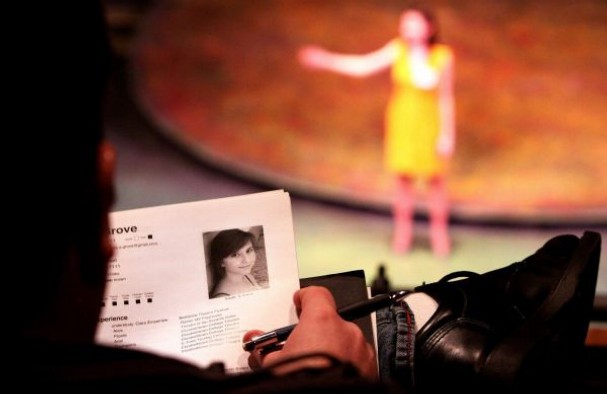
thoughts on auditioning

“Such thoughts as ‘I am a fraud, I am no good, I was terrible tonight’ are the opposite of effective self-improvement. They are obeisance to an outside or internalized authority--they are a plea to that authority for pity on your helpless state. But you are not helpless.”
--David Mamet

Well I had an incredible run of auditions over the past month--I got cast in Terry Dodd’s original play ‘Amateur Night at the Big Heart’ at the Aurora Fox this spring. I was cast in Paragon’s ‘The Seafarer’ for next fall, in a much bigger and more juicy role than I was originally called back for. And I got called back for the Colorado Shakespeare Festival.

And although I didn’t end up getting cast by CSF, in some ways that is the biggest audition of all.

First of all, getting called back for them the first time I went out is huge. Like many less formally-educated actors, I don’t like doing Shakespearean monologue auditions. Don’t get me wrong--I’ve done several Shakespeare plays (as well as ‘The Compleat Works of William Shakespeare, Abridged’ haha) and I actually love several Shakespearean film adaptations (Ian McKellan’s ‘Richard III’ might be in my top five favorite films of all time). So I do have somewhat of a grip on the language--in fact I love the language. It’s not that I don’t understand it or don’t get scansion or the rhythm of the verse. It’s more a psychological thing, I think, to audition Shakespearean pieces for Shakespearean actors/scholars/directors--in other words, for people who do Shakespeare for a living.

It’s intimidating.

But I was determined to be extra well-prepared this year, and as a result I think I FELT the piece I performed for my monologue more than I ever have when I’ve done Shakes monos in the past. And my readings at the callback were also heartfelt and true and honest and unembellished--which brings me back to Mamet’s ‘True and False: Heresy and Common Sense for the Actor.’ Walking out after the CSF callback and during the week-plus afterward while I awaited word, I have never felt so free of anxiety, so unconcerned with how I did at an audition.


Why? Because I was confident I did the work well. I did my homework, went in with confidence, knew what I was saying, and I got where I needed to go emotionally and with honesty. What else could I do? What else can any actor do at any time, on stage or at an audition?

Absolutely nothing. The rest is on the audience if it’s a performance, or on the director and casting director if it’s an audition. Do I have the right look or the right age or the right voice relative to other actors, etc., etc.? All that is none of my concern and there is nothing I can do about it anyway.

As to thoughts like ‘what did they think of me,’ well, these kinds of ideas don’t really even enter into it. Not when I know I’ve done the work the best I can, and know that I’ve done it well. Knowing when I walk out of that room that I had a genuine connection to the words I was saying and feeling is all I can hope for. They’ll pick me or they won’t, but I know with certainty that what I brought was real and genuine and true, and therefore I can’t and don’t really concern myself with what they thought.

It’s incredibly liberating.


One of the best and most useful pieces of advice I ever got about auditioning (and I apologize for not remembering exactly where I picked it up--it may well have been ‘The Practical Handbook for the Actor,’ which was written by Mamet protégés) was that you should find a reason--any reason--going in to every audition, why you DON’T want to be cast. Say to yourself, for instance: it’s a long drive to this theatre, the director is kind of a prick, the script is weak, the show would conflict with another show you might like to do, etc.

It’s a useful kind of psychological jiu-jitsu that releases you from the stark terror of pre-audition jitters, which often revolve around utterly useless and even debilitating thoughts like ‘Will I be Good Enough? Will I Screw Up? Will they LOVE ME?’ These kinds of thoughts are all debasing. They psychologically set you up as a lower life-form, as a thing to be judged Good or Not Good, and they give away any kind of power or psychological edge you might have had.

They make you weak. That is not a good way to feel when you’re about to perform.

Of course, you are being judged when you audition. On the other hand you are not a child. You are not there to show daddy your latest math test in hopes that he pats you on the head and puts it on the fridge. You are not a six-year-old, blinking wide-eyed in hopes that daddy won’t instead be grumpy after a long day and ignore you, thus judging you as A Failure.

Fuck that. You are a grown-up who has a work ethic, a drive, a set of skills and a unique way of looking at the world. You have--no, you ARE a unique set of experiences that could offer any show many things of value.

Did I want to get cast by CSF? Of course I did. But I now have the opportunity to do one or two other shows this summer that I wouldn’t have been able to do otherwise. When I roll in to doing ‘August Osage County’ late this summer it won’t be on a wave of exhaustion, on the tail end of working on CSF shows for the previous three months. I’ll have more time to work with Visionbox on my own plays and other original pieces. Plus I am better-positioned to audition for CSF next year--they’ve seen me now, and they know I can do the work; the first hurdle of apprehension--on THEIR part--has been crossed.

Don’t mistake: this is not the little kid sniffling as he walks home from the baseball game where neither team picked him and muttering, ‘Fine. Screw you guys. I didn’t want to play anyway.’ I promise you my sense of relief is genuine, not some self-amelioration in a sad attempt to mask my pain.

Would CSF this year have been a huge opportunity? Yes, of course. Do I have a shit-ton of other opportunities this summer that I haven’t even begun to examine? Oh Yes.

This all might sound slightly insane, like slightly new-agey psychobabble, a jedi mind trick hiding some deeper pain at being rejected or something. I promise you, for me it is not.

To me what is truly insane is living or dying on the opinions of others. It is a sense of neediness, co-dependence and erasure of the self that we would never tolerate in any other aspect of life. Why should we do it in the context of auditions?
“Do not internalize the industrial model. You are not one of a myriad of interchangeable pieces, but a unique human being. And if you’ve got something to say, say it, and think well of yourself while you’re learning to say it better.”
--David Mamet

Sunday, January 29, 2012

some thoughts post-Othello Project

Nothing like laying around in bed until noon (actually closer to 1:00) the day after an opening. That was my Saturday, followed by a ‘Six Feet Under’ marathon and finally reaching the Acceptance phase with my pet cold--I shall name him Iago. He has been threatening doom this past week, whispering in my ear of betrayal as the stress of tech week loomed.

Acceptance that one is sick is something one cannot abide during tech week--I usually stick with Anger and Denial. Deny, deflect, and apply Emerg-N-Cee powders internally and externally as needed. (Rubbing orange powder all over my face and forehead, paying special attention to the sinuses? Why not. Might work. I shall weep tangerine tears all week.)


Of course the sad thing about this opening weekend for this phase of ‘The Othello Project’ is that it is also closing weekend. One night only, for this incarnation of the show, which is somewhat frustrating and feels like a triumph in the same breath in which it is a bit of a let-down. But of course this is only Phase One, so there is more to come. And it is my first time working with the wonderful people of Visionbox--a nascent theatre ensemble and studio--but hopefully not the last.

The project is the brainchild of Visionbox founder Jennifer McCray Rincon, and the piece we put on was just the bare-bones version of what will eventually be the first act of the completed project. As Jennifer points out, Bill Pullman’s similar (but not similar at all) multi-media project on which she worked took over five years to develop from a thirty-minute staged reading piece into a full-blown three-hour, fully-performed event.


So it’s all good, and it’s really good to be on board at this stage of the project, because I can see it developing into something amazing. In this incarnation of the piece, Jennifer has inter-cut scenes from Othello with pieces from Simone de Beauvoir’s writings on gender, as well as some truly harrowing scenes taken from police interviews and court transcripts documenting a convicted murderer’s account of the stalking, rape and brutal slaughter of his ex-wife.

We had a house of maybe 80-100 people, and I definitely heard some laughter in certain spots, as well as sniffles and uncomfortable shifting around during the recounting of the murder. Also, with an audience--as always--the performances took on an extra heightened urgency; some parts of the Othello text were ‘en fuego,’ as they say.

It has been a great group to work with, and I look forward to working with Visionbox again. Jennifer is trying to set up a true ensemble, a group of people who work together on various projects, readings and shows, as well as in classes and doing studio work together, something I have never been a part of.

And which is sadly lacking in the area. Aside from Buntport and LIDA, as far as I know, there aren’t any true ensembles who put together original work--and I don’t think either of them have studio-type classes and workshops for actors. (I do NOT count any of the various improv groups. Generally speaking, calling improv groups and their performances ‘theatre’ is akin to referring to Applebee’s as ‘fine cuisine.’)


One big problem with the way things are done in most smaller to mid-level houses in the Denver/Fort Collins area is that actors are treated as the lowest life-form in the theatre biosphere. We come in for auditions, wide-eyed and hopeful, grateful for any scrap we are tossed, just happy to be cast. And if we are cast, we are brought in as freelance cowboy gunslingers from show to show, expected to devote and donate weeks and weeks and hundreds of hours of our time to put up a show that benefits only the theatre. You may be helping to ‘build a brand,’ in terms of helping a given theatre and director put on a quality show and build an audience, but once the show closes, you get...what? The opportunity to audition again? To go straight to callbacks? To again work for nothing? You as the actor are not truly part of the theatre, not their success nor their failure.

(SIDEBAR: I grant that there is invaluable learning that one absorbs working on any show; that is where I got the bulk of my theatre education, working on shows. But there comes a breakover point where being expected to essentially pay for an education in the form of time and effort is no longer a bargain for the actor.)

After a show closes, we are tossed aside--once we’ve helped with strike, of course--then left in the cold until the next round of auditions, having been sent on our way with a check that usually pays us something on the order of 25 to 50 cents an hour, including time spent rehearsing and learning lines on our own outside of rehearsals.

And of course, we are referred to as ‘family.’

Which is great, don’t get me wrong, and not unappreciated--the family part, that is. But the 'family' designation is also a bit disingenuous; one is 'family' only as long as the show is up. And the truth is it isn’t a sustainable model, not if the true intent is to create not only quality shows, but also a real family, a solid, core group of talented people who will and do and are capable of coming together and putting up consistent, quality shows. If you only pay directors, and costumers, and set designers and administrators anything even remotely approaching what their time is truly worth, then what are you left with?

You are left with actors who are expected to work for nothing.


And of course there is a place for free, unpaid theatre. People can only learn so much from college theatre productions. And I’m not suggesting I or anyone else should or could get rich doing theatre.

But think about this: at the next level, something above community theatre, somewhere where you charge people two or three times the price of a movie ticket to see your shows, why on god’s green earth would you put in all that time and careful effort, spend all that money on sets, design, direction, publicity, and administration--not to mention rent, lights, and insurance--and then completely neglect one of the main pieces of what it takes to put on a truly great show? You’re going to cheap out on the people who are actually going to PERFORM? Why would you scrimp on the last line of contact between your theatre and your audience?

It is insanity.

Because I can tell you from experience, you get what you pay for. Oh, sure, you can get some wonderful performers and performances out of people who will work for nothing. You can and often do. But not always. And not consistently, and never across the board.

So what’s the result? You end up with a board of directors sitting around bitching about how they never get the respect and coverage the larger theatres get. Well, if every other show you put up is great, top-quality and all that, you should be very proud. But if every other show you put up is amateurish because you are using, well, amateurs, because you are too cheap to pay for quality actors, then you have no one but yourself to blame.

And by the way, the money spent on the people who harangue and harass and beg the public for money through email and phone calls and pre-show announcements? Who organize an endless, ongoing string of fundraisers using donated items and donated talent and yet more donated time? You might not have to work so hard at that part if you put up consistent, quality shows. If that were the case, people might be coming to you and offering to help in whatever way they could.

What invariably happens is theatres of this size become temporary lily pads for quality actors who are not only talented but also devoted to doing the work necessary to get better. These smaller theatres chase these actors away, eventually, through not only a paucity of pay, but also through a lack of investment in actors in the form of making them a part of a company, not just treating them as hired guns.

Instead, the theatre must go back to the tedious annual ritual of weeding through the awfulness of open auditions to find the odd unpolished gem on whose back they can ride for a season or two, before he or she too bails out for greener climes.


Hint. At auditions you are not the one holding the leash.

(SIDEBAR 2: I fear I say all this at risk of sounding like an ingrate. Understand: I love and adore many, many people and theatres I’ve worked with. I am not angry, nor am I resentful. I am in fact enormously grateful for the gifts I have been given by people I’ve worked with, as well as those gifts I have discovered within myself through the efforts of people of the theatre and through working on shows. I merely wish to point out that the accepted way of doing things is askew; it’s very weird and twisted when you think about it. And we never look at it as such, we just accept it. Maybe it’s time to think about another way of looking at things.)

If you want to play with the big boys, pay like the big boys. Or at least start approaching the problem from a different and more equitable direction. Treat your actors like something more than meat props, as something easily replaced by the next warm body that comes along that stands at a similar height, has the requisite genitalia, and can remember more than two lines of dialogue at a time while not breathing through his or her mouth. Because the current model does a disservice to everyone: to your actors, your theatre, and your audience alike.

If we can agree that quality and depth and breadth of support for a given theatre is directly related to the quality of the performances they put on, then it follows that said theatres should do whatever they have to do to ensure they get the best performances possible.

We all know you get what you pay for. If you spend all your money on administration and set design, don’t be surprised if that is what you end up with: administrators standing before lovely sets begging half-empty houses for more money on top of the overpriced ticket they just bought to the half-assed show/debacle they are about to witness.

For you will have no one of quality to perform, and your audience will go home disappointed.

Make an investment in your actors. Make them part of something larger than the next show coming down the pike, and I guarantee they will make an investment in you. As will your grateful audiences.
###

Saturday, January 21, 2012

theatre heresy

One of my favorite comments that I get from actors I’ve just met who come from a theatre school or theatre grad school background is that my acting is ‘...very naturalistic.’ Or ‘organic.’

Now, I am not so stupid as to miss the underlying intent of comments like these; unsults are hilariously pathetic to me, the product of people so weak and insecure and false that they can’t even come right out and honestly dislike something or someone; they must couch their bitterness and distaste in false praise.

And of course there's truth in these comments, and they are not always meant snottily.

But honestly I always take comments like this about my acting as compliments. To me there’s nothing more painful in the world of the stage than watching someone ‘act-act,’ as they were taught to do by some well-meaning but douchetastically inept instructor.


So when I got David Mamet’s ‘True and False: Heresy and Common Sense for the Actor,’ I was deeply gratified to see that Mr. Mamet supports my views and my (admittedly accidental and back-assward) education in the theatre.

I just read nearly the whole thing in a night (and mostly re-read it immediately after I finished it) and I recommend it highly to all my actor friends, and even to anyone remotely interested in what acting and theatre entail. It could even be read as a treatise on what it is to be honest in one’s life, true to oneself and emotionally honest with our fellow humans in a larger sense.

Most people familiar with the man’s work either despise Mamet or worship him; there rarely seems to be a middle ground. But it’s hard to argue with his success: 30 years of writing for the stage, for film and for television, directing, acting, a Pulitzer, Oscar nominations--all of this gives him a unique perspective when it comes to performance and what it takes for an actor to deliver.

And what he does here is burn to the ground a number of sacred cows, starting with theatre education:

'Let me be impolite: most teachers of acting are frauds, and their schools offer nothing other than the right to consider oneself a part of the theatre. Students, of course, need a place to develop. That place is upon the stage. Such a model can and probably will be more painful than a life spent in the studios. But it will instruct. And it is probably finally kinder to the audience to subject them to untutored exuberance than to lifeless and baseless confidence.'

Is that not the shit!?!?!? '...lifeless and baseless confidence...' --only Mamet.

Another:
'Here's what I learned from a lifetime of play-writing: it doesn't matter how you say the lines. What matters is what you mean. What comes from the heart goes to the heart.'

Mamet reflecting the old hip-hop adage, 'Real recognize real.'

And it's true. So many actors feel the need to twist and vocally mangle the words in front of them in order to infuse them with some meaning that simply isn't there. I worked with an actor some time ago who absolutely refused to simply say a very funny playwright's very funny lines as the jokes and punchlines they were intended to be. The result was quirky, indeed, which I'm sure was the intent, but it was also not funny, and not at all genuine.

The result was a person trying very very hard to look more interesting--which is of course self-absorption, which is of course the opposite of acting, which, we are all told all the time is Listening. If you're so busy listening to the sound of your own voice and the funny little kooky quirks you put into it, how can you possibly be listening to anyone else on the stage?

And possibly my favorite quote of all:
'Invent nothing, deny nothing, speak up, stand up, stay out of school.'

More on this later.

the othello project

Here's the press release for 'The Othello Project,' the latest theatre piece I'm working on. It's a wonderfully collaborative piece with a fantastic and fantastically talented cast, but it is no doubt the brainchild of the awesomely talented and wonderful Jennifer McCray Rincon of  Visionbox.

We perform one night only in this incarnation, next Friday the 27th, so I hope you can make it! (FREE FREE FREE FREE FREE FREE FREE...you get the idea. :-)


.

The Othello Project, Phase I
A free multimedia performance event
January 27, 2012, 6-9pm
L2 Arts & Culture Center
1477 Columbine St., Denver 80206

As part of the production, there will be an art show by local artists in the L2 lobby from 6-7pm. At 7pm, in the upper auditorium Visionbox will present The Othello Project, Phase I, excerpts from a new low-friction adaptation of Othello combining Shakespeare’s text and characters with contemporary scenes of Domestic Violence. The production is conceived, adapted and directed by Jennifer McCray Rincon, Executive Artistic Director of Visionbox. Following the performance there will be a talk back with members of the Crime Victims Advisory Council, a unit of the Victim Services Network, part of the Denver District Attorneys Office and the cast and the creators of the project.

Tickets to the show are free.

The material you will see on January 27th is the beginning of a full length production we will present to the public in May 2012. Please be advised that the material contains scenes of graphic violence and is for mature audiences only.

We are also writing to remind you of our January 2012 match grant campaign, initiated by Amber and Mike Fries after our December 8th performance event with Bill Pullman. Amber and Mike Fries have agreed to match every dollar we raise by the end of January up to $50,000. We hope you will consider a donation at this time. No donation is too small...or too big. A contribution of $250 or more will come with 2 free tickets to The Othello Project in May 2012, and a contribution of $5000 or more will include free tickets to all of our 2012 events and VIP parking!

To make a contribution, and for more information about classseswebsite, Visionbox.org, or checks can be made out to CNDC FBO Visionbox and mailed to CNDC 4130 Tejon St., Suite A, Denver, CO 80211. Visionbox is a project of the Colorado Nonprofit Development Center, and contributions to CNDC for the benefit of Visionbox are tax-deductible to the extent permitted by law.

We need your help now to ensure we can bring the excellence and diversity of our programming to as wide a community as possible. Please help us as:

“The Great Work Begins” (Angels in America by Tony Kushner)

Sincerely,
Jennifer McCray Rincon
Executive Artistic Director

Monday, January 2, 2012

acting quotations

Found these at various sites when I was looking for quotes regarding the differences and similarities between stage acting and screen acting. There's a whole crop of younger actors around these days who seem to think that what one does on stage is radically different from what one does on camera, and I just don't think that's true.

Can you act? Can you, as someone besides yourself express emotions, demonstrate desires, go after objectives? This is all acting is. It may be bigger and louder on stage, it may be smaller and more intensive on camera, but it's the same goddamn thing.


To me people who shriek about how much different film acting is are people who don't really know how to act. They have no sense of what acting actually is, and because they sense this paucity or weakness or lack of knowledge or skill in themselves, they react as the insecure always have and always will: they cover it by applying a false superiority to themselves.

In a more generous vein, I would assert that perhaps people who have seen stage actors bomb before the cameras have been subjected to what I would delicately call 'bad acting,' not necessarily 'stage acting.'


Here's some related and unrelated quotes:

"[Human beings] will begin to recover the moment we take art as seriously as physics, chemistry or money." - Ernst Levy

"I regard the theatre as the greatest of all art forms, the most immediate way in which a human being can share with another the sense of what it is to be a human being." - Oscar Wilde

“Invent nothing, deny nothing, speak up, stand up, stay out of school.”
― David Mamet, True and False: Heresy and Common Sense for the Actor

“Art is an expression of joy and awe. It is not an attempt to share one's virtues and accomplishments with the audience, but an act of selfless spirit.”
― David Mamet, True and False: Heresy and Common Sense for the Actor

“All drama is about lies. All drama is about something that’s hidden. A drama starts because a situation becomes imbalanced by a lie. The lie may be something we tell each other or something we think about ourselves, but the lie imbalances a situation. If you’re cheating on your wife the repression of that puts things out of balance; or if you’re someone you think you’re not, and you think you should be further ahead in your job, that neurotic vision takes over your life and you’re plagued by it until you’re cleansed. At the end of a play the lie is revealed. The better the play the more surprising and inevitable the lie is. Aristotle told us this.” ― David Mamet

"The articulate, trained voice is more distracting than mere noise." - Seneca

"Man is a make-believe animal: he is never so truly himself as when he is acting a part." - William Hazlitt

"In theatre, I have been able to take parts I didn`t think I could do - you have time to rehearse and learn. In movies, they want you to do what they know you can do - there isn`t the time." --Ian McKellan

the wisdom of bunnies

Photobucket


Donnie: Why do you wear that stupid bunny suit?
Frank: Why are you wearing that stupid man suit?

Sunday, January 1, 2012

Happy New Year

Welp, that was weird.

2011, I mean. By any measure, that was a strange year. A damn strange year.

On the surface it doesn’t seem so weird: did a bunch of shows, moved to Denver, wrote some reviews, carved a new script (almost done) out of a weird kernel of an idea.

I'm working on 'The Othello Project' with Visionbox, a sort of hybrid Sakespearean show inter-cut with interviews and court documents of domestic violence victims and perpetrators.

I just auditioned for Terry Dodd's original show, 'Amateur Night at the Big Heart,' and the week after next I'm reading for Creede Rep, Paragon's production of Conor McPherson's 'The Seafarer,' and for the Colorado Shakespeare Festival(!!!!) Wish me many broken things, as I'm going to need it. :-)

We'll see...

Other than that?

Blogged. Reddited (strictly a lurker; I don’t handle rejection well, haha.)

Fell in love, fell out of love. Both of which were against my will, haha. Which is the weirdest thing of all, in some ways. Because I really, honestly didn’t think I had that in me anymore. But no, I (foolishly, awesomely, retardedly, joyfully) remembered for a brief moment what it’s like to feel real emotions--not just the stage kind--and as usual I got burned.

I think that’s largely my fault; a pattern emerges for he who has eyes to see. I have a tendency to put too many eggs in the proverbial basket. And that is only if and when I discover in my clunky way that a basket might potentially exist at all, haha. No, I tend toward either complete misanthropy, complete separation from other humans, or, conversely, a naïve hope that on some level, there is, there MUST be some perfect, complete understanding.

As I always say, I believe the biggest cynics are actually the biggest romantics, because we envision something infinitely greater than the shite world that's in front of us.

But in my naiveté, I seek an erasure of self--of selves--that would mean total understanding, total connection with another, but which is, of course, impossible.

We are born alone, and we die alone. Although we like to imagine it to be otherwise in between, we are always alone.

No person can ever truly know another.

But I think this feeling that comes around from time to time for me, the feeling that I want and need to connect with someone on that level--or that it is even possible for me to connect on that level--is so strange and leads to such vulnerability that when these things end it can’t help but lead to trouble for me. When you strive to--or perhaps naturally--feel nothing or less than nothing for others much of the time (off-stage that is, haha. I’m really good, I like to think, at feeling other people’s feelings--just put a script in my hands. :-) those moments when real emotions flood in can be overwhelming. Probably not only for me, haha.

Whatever. I’m okay. I always am; I always end up okay, eventually. Making oneself emotionally available is a bitch, at least for me. But I always come around, afterward, when I come back down to earth. I think, long-term, it’s just wiser to keep my distance, however awful that sounds.

Feel things on stage; leave them there.

Rubbing of parts aside
, I think this should be my mantra. :-)

(Or maybe my mantra should be 'Rubbing of parts aside...'

At any rate, I have learned a lot this year, about myself and about how the world works. And really, can anyone ask for anything more than that? I am delighted to--even at my grizzled age--still be learning. I think one of my favorite things about doing shows is meeting other actors and learning from them.

Especially younger actors. I’m speaking not necessarily of the ‘rubbing of parts’ :-) or learning technical things--acting things or theatre school wisdom or anything like that, although all of that happens too, when I’m lucky--but more of learning about life and myself. There’s an energy and enthusiasm that I leech off of younger actors, and often a simple joy, a sheer, blind, dim-witted happiness at simply being alive that younger people often have, whether they know it or not, and it feeds me. It saves me, however briefly, from my natural gloom.

And this is the first year that I finally came to the realization--or acceptance--that I am someone people look up to, as an actor at the very least, and perhaps in the larger world too.

Trust me when I say this isn’t braggadocio. I am insecure to the point where it takes some convincing for me to believe that I have anything at all to offer others. I am at my core a selfish, self-conscious, doubtful person who spends a great deal of time worrying about how fucked up I am and/or appear to other people.

But this year, especially in Pagosa Springs, I finally copped to the notion that people like and perhaps even admire me. And as vain as that sounds, I swear it isn’t meant to indicate a one-way street.

They watch me, I watch them.

And each of us learn from it.

Somehow, seeing yourself through another’s eyes teaches you way more than you might ever hope to learn through quiet reflection or yoga or meditation or booze or classes. To me, anyway. It's like a photograph: you can peer at yourself in the mirror as long as you like, but you will never truly see yourself there like you will when you look at a picture of yourself. this is because the picture is looking at you through someone else's eyes, even if that someone else is just a camera lens.

There’s a joy I vampirically take in hanging out with people younger than I am. I suck their energy and enthusiasm and hopefully return something to them in the way of knowledge and smarts, or perhaps just my own goofiness and immaturity. :)

As an insecure person, I am always floored when I perceive people looking up to me, whether as an actor or as a person (meaning: an actual PERSON, a non-actor...a human, haha). Frankly, it’s even weirder when they think I know something about acting, or even more strangely, life; I may know a little, in strictly my own way, my nonsensical, non-structured, purely organic, instinctual thing...funny how educated theatre people always say something like, ‘you have good instincts!’ haha...)

SIDEBAR: Interestingly, I seem to approach both life and theatre in much the same disjointed, haphazard, seat-of-the-pants way...


But as little as I know about acting, it’s possible I know even less about life. I often feel like I don’t know a damn thing about living and what it takes to be a human in this world.

Surely, whatever dubious knowledge I may have is not anything that should be passed on.

My bad decisions are legion. I must echo Hunter Thompson when I say, ‘I hate to advocate drugs, alcohol, violence, or insanity to anyone, but they've always worked for me.’

A good craftsman always blames his tools. Or in my case, his tool. :-)

With regard to acting, my bad decisions have led me down a twisting, kooky path that has reaped great rewards. (Until people catch on and realize how full of shit I am, how much of a faker and charlatan I am, I’m going to ride it out. :-)

I’ve been lucky to work with directors and actors who were patient and had a lot to give. But this path is strictly my own; bashing your head against a wall over and over is something I inevitably do, but it isn’t for everyone.

I’m not going to do the year-end tally of things I’ve done. If you read this blog, or even if it’s your first time here, there are plenty of entries about the shows I was in last year. (Search for ‘theatre.’ Yes, the snobby spelling. Screw you, John M. :-)

In brief, highlights include ‘Equus,’ (where I learned a great deal about horses and repressed emotions) ‘Little Shop of Horrors,’ (my first musical since high school; musical theatre actors are freaks, haha :-) ‘The Grapes of Wrath’ (in which I got to play a ‘nice guy,’ for once, although he was a broken-priest-turned-atheist, alcoholic, womanizer...hmmm...type-casting?) And my greatest show of the year, and perhaps of my career thus far, ‘The Lion in Winter.’


My dad didn't recognize me in this pic when I showed it to him over Christmas. True Story.

I have gone on ad infinitum about Pat Payne, the director of ‘Lion,’ and Tim and Laura, the proprietors of Thingamajig Theatre and the Pagosa Springs Center for the Arts, so I won’t belabor the point. I will just say that, like the best directors, Pat brought things out of me that I wasn’t even aware were there; he took me to new levels of emotion and expression such that I surely owe him an ongoing debt as I continue acting. And considering we did all that in just seven days of rehearsal, it’s even more miraculous.

And Tim and Laura are the best theatre-running couple that could ever exist. They, atop the heap--as the hosts of this mad thing we tried to pull off in a week in a tiny mountain town under a blanket of winter--made the experience a trickle-down of good spirits, joy, and love.

No bullshit, no egos, no negativity, no doom-saying--which is the way theatre ought to be.

We're all on the same team, after all, aren't we? We all want to put up the best show we can and connect with people, don't we? So why does it always seem like there has to be someone in the cast or crew or production team that seems hell-bent on predicting and/or creating failure?

Anyway.

In short, while I don’t believe in God or blessings, I do believe in luck.

And I am lucky. And grateful to all the people I have met in my life: you have made me who I am. I am grateful to life, the universe, and everything to have been one lucky motherfucker this year.

Big thanks to everyone who I brushed against (not RUBBED UP against...although...come to think of it, thanks to you too! :-)

In all seriousness, you all have made an impact on me, even if it’s in a way I can’t express. You know who you are, or even if you didn’t before, know now that you move and motivate me.

I am a better person for having met you, for having you in my life.

Peace, and much love as we approach the end of days,

(thanks SO much for that, Mayans...)

--kjb


I'm not getting all mopey or emo, I swear. This is just what came up when I googled 'We are born alone, and we die alone.' :-)